What Buyers Should Know About Sourcing hotel lighting from China
Hotel lighting sourcing works best when the buyer aligns the fixture schedule, room design, technical submittals, market approvals, supplier controls, and delivery plan. A catalog name alone does not confirm that the quoted driver, optics, controls, finish, and certification match the project. Keep the accepted model and its evidence traceable from sample review through site installation.
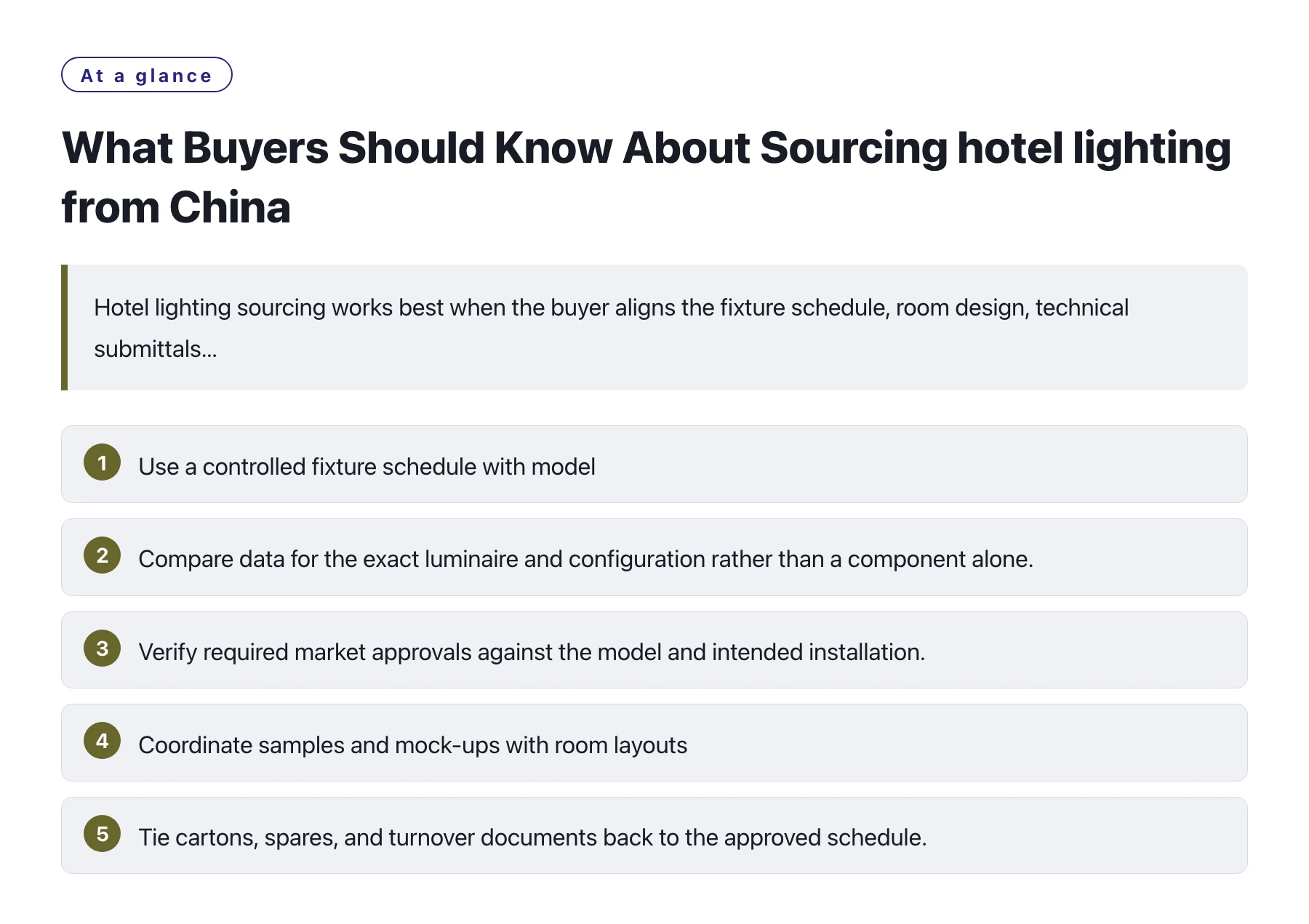
Key takeaways
- Use a controlled fixture schedule with model, finish, controls, and performance requirements.
- Compare data for the exact luminaire and configuration rather than a component alone.
- Verify required market approvals against the model and intended installation.
- Coordinate samples and mock-ups with room layouts, ceilings, and control scenes.
- Tie cartons, spares, and turnover documents back to the approved schedule.
Hotel lighting combines visual intent with electrical, ceiling, controls, maintenance, and project-schedule requirements. A disciplined sourcing plan makes those interfaces visible before fixtures enter production.
Translate the design intent into a fixture schedule
Before requesting prices, prepare a fixture schedule that identifies each luminaire by tag, location, quantity, mounting type, dimensions, finish, and intended function. Reference the approved design drawing and list required photometric, electrical, control, and environmental characteristics. Distinguish fixed requirements from acceptable alternates so the supplier knows which details may be proposed and which require approval.
For hotel projects, coordinate lighting with ceiling systems, furniture, joinery, signage, and room controls. Confirm cutout dimensions, driver locations, access panels, dimming interface, emergency functions where relevant, and any special finishes visible to guests. A fixture that meets a catalog description may still conflict with the ceiling, service access, or operating scene required by the design.
Name the party responsible for engineering review. A lighting designer or electrical engineer should resolve technical values and compatibility; procurement can normalize offers and document exceptions. If the supplier proposes a substitution, ask for model data and evidence against every affected schedule requirement before accepting it.
Compare light output and color characteristics
Ask suppliers to provide data for the exact offered model and configuration. Depending on the project, this may include delivered lumens, input power, efficacy, correlated color temperature, color rendering information, beam distribution, dimming range, flicker behavior, and rated life assumptions. Compare measurements produced under comparable methods and distinguish tested data from catalog estimates.
Review whether the published output applies to the complete luminaire or only to an LED module. Lens, reflector, driver, thermal design, and operating conditions can affect the fixture’s actual performance. Confirm the specified voltage, driver, control protocol, and any emergency or sensor package, since options may change the model and its documents.
If the design depends on a particular appearance, request samples or a mock-up in the actual finish and approximate installation conditions. Compare color, glare, beam, surface reflection, and dimming behavior in the room context. Record the selected variant and any approved range in the schedule rather than relying on an informal verbal description.
Check electrical safety and market approvals
Identify the project destination and the applicable electrical and building requirements before ordering. Ask which certification mark and product documents are required for the market, whether the offered model is listed or recognized for the intended installation, and what evidence covers the driver, controls, and complete luminaire. Requirements differ by market and product type, so a supplier’s general claim of “international certification” is not enough to settle the project review.
UL Solutions describes lighting evaluation across lamps, luminaires, components, and controls and distinguishes complete end products from recognized components.[1] If a UL mark or another certification is required, check that the exact product identity, model, factory, and intended use match the relevant listing. Ask the responsible authority or certification body to resolve ambiguous scope; do not infer approval from a logo image in a brochure.
Create a submittal checklist with model code, installation instructions, wiring diagrams, test reports, certification evidence, driver data, warranty terms, and change-control contact. Review each document’s issue date and model scope. Keep the accepted set with the approved fixture schedule and purchase order.
Assess supplier capability and production control
Confirm which company designs, assembles, tests, and ships the fixture. The sales contact, factory, brand owner, and certification holder may differ. Identify the actual production site and any subcontracted processes such as metal finishing, optics, driver supply, assembly, or packaging. Ask how the supplier controls these relationships and traces parts to finished product batches.
Request examples of quality checks relevant to the order, such as incoming component verification, wiring and grounding checks, burn-in or functional testing, labeling inspection, and final packaging review. Ask for the procedure or a representative record with confidential details removed. Match the evidence to the product and project requirements rather than treating a factory-wide certificate as proof that every fixture configuration is correct.
Agree that changes to LED modules, drivers, optics, wiring, firmware, factory, or critical materials require notice and review when they can affect photometric output, compatibility, safety, or certification. Define whether a revised submittal, sample, or test report is needed before the updated product is produced.
Review samples, mock-ups, and room-level coordination
A sample should carry its model code, finish, driver, optics, control option, and date. Check that the sample is representative of the intended production item. If a room mock-up includes multiple fixtures and controls, record the components and control settings used so the accepted visual effect can be recreated.
Review interfaces with the electrical contractor and ceiling or millwork trades. Confirm mounting details, ceiling thickness, cutout tolerances, connector locations, service access, and cable routing. A small coordination drawing can reveal conflicts before fabrication or site installation. Assign each open item to a discipline and set a decision date.
Keep approvals distinct: a visual mock-up can be accepted for appearance while technical submittals remain under review. Mark any conditional acceptance and require closure before release. If the room layout or control scene changes, check whether fixture counts, circuiting, driver selection, and photometric assumptions need revision.
Plan delivery, spares, and turnover records
Confirm quantities by fixture tag and room or area, then reconcile cartons and labels to the schedule. Specify packing that protects lenses, finishes, and protruding components. Ask whether fixtures ship assembled or require field assembly, and include installation instructions and accessory lists in the package. Plan delivery around site storage capacity and the construction sequence.
Discuss spare quantities and replacement-part availability with the project team. Identify which parts can be field-replaced, how replacements are matched to the installed model, and what information the supplier needs to identify a failed unit. Do not assume future replacements will have identical appearance or performance if the model or components may change.
Before shipment, check the approved product schedule, sample status, required test and certification documents, package labels, driver/control configuration, and resolved deviations. At turnover, keep final as-built fixture schedules, installation instructions, warranty details, control settings, and spare-parts list. For sourcing and supplier coordination on hotel lighting, buyers can review lighting suppliers for hospitality projects as one project resource while retaining design and code approvals with the responsible specialists.
Sources
Frequently asked questions
What should be included in a hotel lighting supplier quotation?
Request model-specific data, fixture configuration, finish, controls, installation details, required certification evidence, packaging, delivery assumptions, exclusions, and a response to each schedule requirement.
Does a certification logo prove that the quoted luminaire is approved?
No. Verify the exact model, configuration, factory, scope, and intended installation against the relevant certification record and the market’s requirements.
Why does the sample need to include the final driver and optics?
Those components can affect output, dimming, appearance, and compatibility. The approved sample should identify the configuration it represents and be connected to the final schedule.
Who approves technical suitability for installation?
The project’s qualified lighting, electrical, and code reviewers should approve the design and applicable requirements. Procurement and sourcing teams can coordinate evidence and supplier responses.