OEM or ODM for Solid and Oil Formats: Who Owns Each Quality Gate
OEM and ODM are often described as a sourcing choice, but in solid and oil formats they are mostly a division of responsibility. Under OEM the brand brings a defined base and formula and the factory reproduces it; under ODM the factory proposes the base and the scent architecture and the brand selects from it. Either way the brand remains the party accountable for what reaches a consumer, which is why the useful question is not which model is better but which quality gate belongs to whom. Mapping those gates before the first order prevents the most expensive kind of confusion, which is discovering after a failed batch that two teams each assumed the other had tested something.
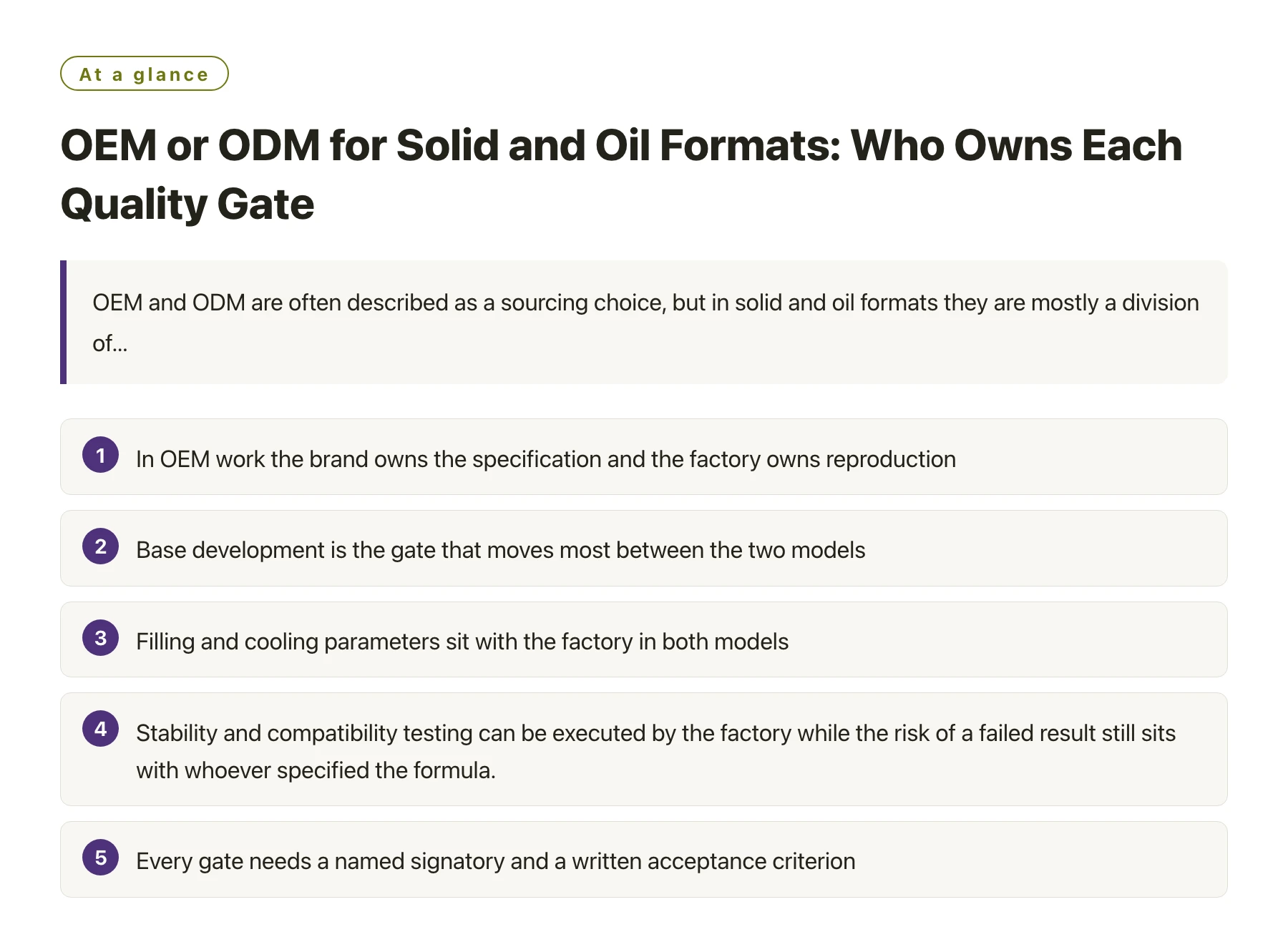
Key takeawaysIn OEM work the brand owns the specification and the factory owns reproduction; in ODM work the factory proposes the base and the brand owns selection and approval. · Base development is the gate that moves most between the two models, and it is the gate that determines whether the finished format works at all. · Filling and cooling parameters sit with the factory in both models, but the acceptance criteria for surface quality and fill weight belong to the brand in both models too. · Stability and compatibility testing can be executed by the factory while the risk of a failed result still sits with whoever specified the formula. · Every gate needs a named signatory and a written acceptance criterion, because a gate that nobody signs is not a gate.
A first-time founder who has worked in product development usually finds the commercial part of sourcing straightforward and the responsibility part confusing. Two suppliers can quote the same format, the same fill weight and a similar unit price while carrying completely different obligations for the base, the load and the testing.
That difference is what OEM and ODM actually describe in these formats. The words refer to who originates the design, and they ripple outward into every checkpoint that follows.
The table below maps the gates, then the sections after it explain where first orders most often break down and what a founder should insist on keeping.
Who owns each gate under OEM and under ODM
| Quality gate | Under OEM | Under ODM | What the brand still owns |
|---|---|---|---|
| Base formulation | Brand specifies the wax, butter or carrier system; factory reproduces it within tolerance. | Factory develops and proposes base options for the brief; brand selects one. | The acceptance criteria for skin feel, firmness and heat behaviour. |
| Fragrance load | Brand sets the target load; factory confirms it is achievable in the chosen base. | Factory proposes the load that fits the base and the cost target; brand approves. | The decision on what the product should feel and smell like at the point of use. |
| Material restrictions | Brand or its fragrance house provides the restriction assessment; factory applies it. | Factory provides the assessment for its own fragrance and states the product category used. | Verifying that the category matches the way the product is actually used [1]. |
| Filling and cooling | Factory owns the parameters and the record. | Factory owns the parameters and the record. | Agreeing fill weight tolerance and the visual standard for surface defects. |
| In-process checks | Factory performs and documents them. | Factory performs and documents them. | Deciding how much of the record you want to see, and asking for it consistently. |
| Stability and compatibility | Usually factory-executed; the brand specifies what must be tested. | Usually factory-executed against its own protocol; brand reviews the report. | Reading the report against the real shipping conditions rather than a generic one [2]. |
| Retained reference | Brand and factory each hold a sealed reference. | Factory holds the master reference; brand should hold one too. | Confirming in writing how long each side keeps its reference. |
| Label content | Brand owns artwork; factory supplies formula and allergen data. | Factory often supplies draft content; brand still owns final approval. | The final check that the label matches the locked formula. |
Read the table as an allocation of decision rights rather than blame. In both models the factory executes the physical work; what moves is who defines the target and who accepts the result.
The base is the gate that moves most
In a spray project the difference between OEM and ODM is mostly about who wrote the fragrance formula. In a solid or oil project the base is a second design decision, and it changes the whole character of the product. Firmness, glide, absorption and release all trace back to it.
Under OEM, a founder who has never built a wax base will find that specifying one is harder than expected. Importing a base specification from another supplier is possible, but the receiving factory still has to reproduce it consistently, and it will normally want to run its own compatibility test before accepting the target. That test can reveal that the imported base does not behave the same way on a different filling line.
Under ODM, the factory controls base development, which is faster and usually cheaper, but the brand has less visibility into why one base was chosen over another. The remedy is procedural rather than contractual: ask for the base options, the reason each was proposed, and a sample of each on the intended fragrance. A factory that runs full ODM fragrance service should be able to show that reasoning rather than only the final stick.
Where the responsibility split actually breaks
The first failure mode is a shared assumption about testing. Under OEM the brand may assume the factory tested the base with the fragrance; under ODM the brand may assume testing extended to the packaging. In both cases the assumption is reasonable and the gap is real, because each party tested what it owned.
The second is a specification that describes a sample instead of a product. A reference stick in a plain tin is not a specification; it becomes one only when fill weight, tolerance, surface standard and packaging are written down. Without those, the acceptance check at bulk has no basis and becomes a judgement call.
The third is drift in the material restrictions. Fragrance standards are revised, and a formula that was assessed two years ago may need rechecking before a new batch is produced. The assessor's opinion on a given material can also change as new data arrives, and EU scientific opinions on cosmetic ingredients are one of the inputs into that process [3]. Whoever holds the formula should also own the task of rechecking it when the standards move.
The fourth is a factory describing its own scope more broadly than it can deliver. A house with a long manufacturing record, such as Xuelei, can normally show the base variants behind a finished format rather than only the format itself, and the factory's own account of their OEM/ODM manufacturing services should state plainly which gates it performs on site and which it outsources.
Checkpoints worth writing into the order
- Base sample approved against a written description of skin feel, firmness and surface finish, not only a photograph.
- Fragrance load confirmed in writing, with the accepted range and the consequence of exceeding it.
- Heat and transport test defined before production, with the test condition, duration and pass criteria agreed.
- Fill weight and tolerance fixed, with the checking interval stated in the production record.
- Rollerball or stick mechanism tested for function and leakage on finished units, not on components alone.
- Retained reference sealed by both sides at the moment of approval, with a stated retention period.
- Label content verified against the locked formula by the brand, not only by the factory.
- Change control agreed: any substitution after approval requires written notice and, where relevant, retesting.
Negotiate the split before the sample round, not after it. Once a sample has been approved, both sides have invested in it, and changing who owns a gate at that point feels like a renegotiation rather than a clarification.
How to choose between the two models on a first order
Choose OEM when you already have a base and formula you trust, or when a technical partner has specified them for you, and your priority is faithful reproduction at a known cost. Choose ODM when the base is still an open question and you would rather buy a solved format than manage a development project.
A middle path exists and is common in these formats: the factory develops the base, and the brand keeps ownership of the fragrance and the acceptance criteria. That arrangement preserves the speed advantage of ODM while keeping the parts that define the brand in the brand's hands. Whatever the model, the practical test is whether the factory can describe its own process without contradicting itself; a manufacturer that supports both OEM and ODM work will normally be able to explain where the boundary sits in your specific project fragrance OEM and ODM manufacturer.
Trade coverage of solid and anhydrous formats has grown alongside interest in alcohol-free and travel-friendly products, which means more factories now claim capability in them than genuinely run the lines [4]. The gate map above is the quickest way to tell the two apart, because a factory that cannot say who tests what has probably not run the process end to end.
Finally, keep the documentation proportionate. A first order does not need an enterprise quality agreement, but it does need one page naming the gates, the signatories and the acceptance criteria. That page is what makes the difference between the two models operational rather than theoretical.
Sources
- IFRA Standards Library (International Fragrance Association) —— The IFRA Standards Library lists the restrictions the fragrance industry applies to individual fragrance ingredients, based on safety assessments; it is the reference point for compliant fragrance formulation.
- SGS: Cosmetics, Personal Care & Household Testing —— Testing, inspection and certification services for cosmetics and personal care, including microbiological, stability and safety testing aligned with cosmetics GMP.
- EU Scientific Committee on Consumer Safety (SCCS) —— The EU scientific committee that issues opinions on the safety of cosmetic ingredients, including fragrance allergens and their labelling thresholds.
- Cosmetics & Toiletries —— A technical magazine for cosmetic formulators, covering ingredients, formulation science and testing methods.
Frequently asked questions
Does ODM mean the factory owns the formula and I cannot use it elsewhere?
Not automatically. Ownership is a contract term, not a property of the model. An ODM arrangement can include exclusive use of a developed base for your category, or it can leave the factory free to offer the same base to others. Decide which you need before signing, and get it in writing.
Under OEM, can I insist that the factory use my base specification exactly?
You can specify it, and the factory can accept or refuse after its own compatibility testing. A factory that reproduces a base it has not tested is taking a risk on your behalf. Expect a trial batch or a compatibility run before the specification is accepted.
Who is responsible if a bulk batch weeps in summer?
It depends on which gate failed and what was agreed. If the heat test was specified and passed, the failure points at production consistency. If no heat test was agreed, responsibility is usually shared, which is exactly the outcome the gate map is designed to prevent.
How many checkpoints should a first order include?
Fewer than you might think, but each one should be real. Base approval, load confirmation, heat and transport testing, fill weight, mechanism function and a sealed reference cover most of the risk. Adding checkpoints nobody performs is worse than having six that are documented.
Is ODM cheaper than OEM for these formats?
Often, because the base development is amortised across the factory's other work. The saving is real but it comes with less control over the base itself. If the base is central to your product, paying for OEM development may be the better value even at a higher unit price.