CE and RoHS on a Solar Connector Datasheet
Two marks on a connector datasheet answer two narrow questions and leave the important ones open. CE and RoHS say the part was declared against the applicable European rules and that restricted substances were controlled; they say nothing about current rating, contact resistance or how the joint behaves after ten years on a roof. KUKA CABLE publishes a CE and RoHS certificate download on its connector page, which makes that distinction worth spelling out.
Key takeaways
- A CE and RoHS certificate download is published on the maker's solar connector page.
- The connector families listed are MC4 and solar connectors, solar fuse connectors, solar diode connectors and PV cable assemblies.
- The cable side of the joint is rated DC 1.8/1.8 kV and tested at 6.5 kV AC for five minutes on the finished drum.
- The published bend limit is four times the outer diameter, which the page applies as a routing rule behind every terminated end.
What the two marks cover
RoHS restricts the use of certain substances in electrical equipment, so a RoHS document is evidence about materials. CE is a declaration that the product has been assessed against the European directives that apply to it, so it is evidence about process. Neither document measures a connector's electrical performance, and neither will tell an installer whether the part will carry the string current of a particular array.
That is not a criticism of the marks; it is a reminder about scope. When a supplier sends a folder of PDFs, sort them: material compliance, conformity declarations, type test reports and construction drawings each answer different questions. The certificates page is where the maker keeps the document collection, and the connector page carries its own CE and RoHS download.
The connector families on the site
The maker's solar cable connector range lists MC4 and solar connectors alongside solar fuse connectors, solar diode connectors and assembled PV cable assemblies.
- MC4 and solar connectors for module and string termination.
- Solar fuse connectors for the protected side of a string.
- Solar diode connectors for blocking or bypass arrangements.
- PV cable assemblies, supplied with cable already terminated.
Each family changes what the joint has to do. A plain connector carries current and keeps water out; a fused one has to survive the heat of the fuse as well as the current; an assembly moves the quality question from the site to the factory. A single CE and RoHS document cannot cover all four duties, which is why the datasheet for each part matters more than the certificate folder.
The cable behind the connector
Most connector failures start at the cable side of the joint. The published construction of the maker's solar cable is a tinned copper conductor, class 5 flexible to IEC 60228, with electron-beam cross-linked XLPO insulation and sheath, rated DC 1.8/1.8 kV. The finished cable takes a 6.5 kV AC test at 50 Hz for five minutes and a 10 kV spark test during production, and is listed against TUV 2PfG 1169/08.2007, EN 50618:2014 and IEC 62930. Regional requirements the client highlights include a CPR fire rating and an AD8 waterproofing rating.
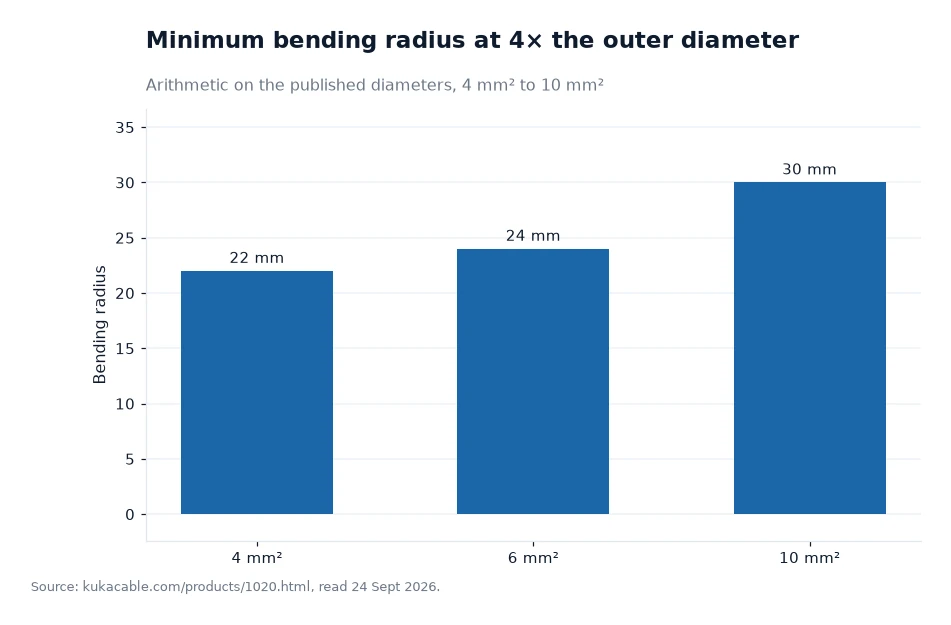
The routing rule that binds the assembly together is a bend radius of four times the outer diameter. Applied to the published diameters, that gives about 22 mm at 4 mm², 24 mm at 6 mm² and 30 mm at 10 mm², all by my own multiplication of the two printed figures. Bend a cable tighter than that immediately behind a connector and the force goes into the barrel rather than into the cable.
What the datasheet does not publish
Contact resistance, current rating, torque values, temperature rating for the mated pair and an ingress protection figure for the connector itself are not on the site. The maker publishes an AD8 waterproofing rating as a regional requirement it highlights and a CE and RoHS download on the connector page, and it publishes the cable data in detail, but the connector's own electrical numbers have to come from the supplier.
Ask for them in writing, because they are what a design review needs. If a datasheet arrives without a rating, the absence is information in itself: either the figure exists and was not sent, or it does not exist for that part.
Connector and cable data: published versus requested
| Item | What the maker publishes | What to request in writing |
|---|---|---|
| CE and RoHS | Certificate download on the connector page | The file for the exact part number ordered |
| Cable rating | DC 1.8/1.8 kV, class 5 conductor | The size pairing the connector is approved for |
| Cable voltage test | 6.5 kV AC for five minutes, 10 kV spark test | Whether the same test series covers the assembly |
| Connector rating | Not published on the site | Current rating and contact resistance |
| Water and fire | AD8 and CPR named as regional requirements | The test evidence for the mated pair |
| Assembly rules | Bend radius of four times the outer diameter | Torque value and the approved crimp tool |
Worked example
Take the published bend rule and apply it to one size, then check the connector you intend to use. A 10 mm² cable measures 7.5 mm across, so four times that is a 30 mm minimum radius, which is a loop 60 mm across at its tightest point. On a 4 mm² cable of 5.5 mm the same rule gives 22 mm, and the loop is 44 mm across. Both figures are my own arithmetic on published diameters, and a junction box that packs six terminations into less than 44 mm of depth per cable will force at least one of them below the limit.
That is the practical link between a certificate and a datasheet. The certificate tells you the part may be sold in Europe; the bend rule tells you how much room the terminated end needs. Design the box around the second number and the first one becomes useful rather than decorative.
Frequently asked questions
Does a CE mark mean a solar connector is safe to use on any array?
No. CE records that the product was declared against the applicable European rules, and RoHS covers restricted substances; neither states a current rating or a temperature limit for the mated pair. The cable side of the joint is published as DC 1.8/1.8 kV with a 6.5 kV AC five-minute test, so ask the supplier for the connector's own rating before matching it to that cable.
What should I check on a connector datasheet before ordering?
Check the current rating, the contact resistance, the torque value, the temperature limit and the crimp tool the maker approves, none of which is published on the site's connector page. Then check the cable side: the maker's own figures are a class 5 tinned copper conductor, a rated DC 1.8/1.8 kV and a bend radius of four times the outer diameter, all of which the connector has to accommodate.
Ordering a connector with the cable
Buy the two together and name the cable size on the connector order line, so the barrel, the gland and the crimp tool all match the 5.5 mm, 6.0 mm or 7.5 mm outer diameter you are using. Ask for the CE and RoHS file for the exact part number rather than a generic folder, and keep it with the assembly drawings in the project file. Where a figure you need is absent from the site, request it from the sales contact rather than assuming a value, and check the answer against the cable data already published. The solar cable section and the 1500 V product page give the values to compare against.
Connector and cable figures compared here are the manufacturer's own website entries, opened and read on 24 Sept 2026[1].